
Begin with the term that the cashier screen never shows you. Section 9.14 of the 7Bit terms requires that every deposit be staked at least three times on slots, or ten times on table and live games, before a payout can be requested, and it lets the operator hold any payment back until that turnover is covered. No bonus is involved. Fund an account, decline every promotion on the site, win on an early spin, ask for your money, and the rule still stands between you and the cash.
Everything else on this page is better than that, some of it considerably better. The cashier served to a Canadian address is one of the more honest ones in the offshore market: Interac heads the deposit tab, every limit is quoted in Canadian dollars instead of being converted at the till, and Bitcoin opens an account at C$6. But a payments page has to be organized around what can go wrong with your money, and clause 9.14 is what goes wrong most quietly.
The term that decides when you may cash out
Here is 9.14 in full, as it was published on 20 October 2026, under the heading “Payments Policy” rather than anywhere near the bonus rules:
“Funds deposited to the Casino are intended for entertainment purposes only. Any deposits need to be wagered at least 3 times, table/live games at least 10 times playing real money. The Casino reserves the right to cancel any payments until you have fulfilled the deposit wagering requirement.”
Three features of that sentence deserve attention. The first is where it lives. A bonus wagering requirement is something a player opts into by clicking a promotion; this one attaches to the act of depositing, so it governs the cautious player who never touches an offer exactly as firmly as it governs the bonus hunter. The second is the split between game types. Slots clear the obligation at three times the deposit; anything played at a table or against a live dealer clears it at ten times. The third is the enforcement language. The casino does not say it will void a withdrawal; it claims the power to cancel payments until the requirement is met, which in practice means a request bouncing back to your balance rather than a refusal you can argue with.
One thing the clause does not do is define what counts. It says “playing real money”, which rules out spins funded by bonus credit, but it does not say whether a bet placed and immediately cashed out of a crash game counts the same as a completed slot spin, and it is silent on whether the counter resets per deposit or runs cumulatively across an account. We read the payments policy twice looking for that detail and it is not there.
For context on how unusual this is: the same operator publishes a twelve-level loyalty ladder down to the cent and a verifiable fairness method with a worked hash example. It discloses plenty. It simply does not put 9.14 anywhere a depositing player will trip over it.
What 3x and 10x cost, in dollars
The arithmetic is simple enough to do in your head, which is why it is worth putting on the screen. Multiply your deposit by three for slot play, by ten if you sit at a blackjack or roulette table, and that is the turnover standing between the deposit and a withdrawal request.
| Deposit | Slot turnover required at 3x | Table or live turnover at 10x |
|---|---|---|
| C$20 (the floor) | C$60 | C$200 |
| C$40 | C$120 | C$400 |
| C$100 | C$300 | C$1,000 |
| C$500 | C$1,500 | C$5,000 |
| C$1,000 | C$3,000 | C$10,000 |
| C$3,000 (the Interac ceiling) | C$9,000 | C$30,000 |
| C$8,000 (the card ceiling) | C$24,000 | C$80,000 |
What that turnover costs you in expectation is a question we cannot answer, and it matters that we say why rather than estimate. 7Bit does not publish a return-to-player percentage for a single game, nor for a whole category, so there is no disclosed house edge to multiply that turnover against. A reader who wants to run that calculation needs an RTP number, and the operator does not supply one. We have left the column out rather than fill it with a market average borrowed from somewhere else.
The practical reading is this. At the small end the requirement is almost invisible: C$60 of slot spins on a C$20 deposit is a short session. At the top end it becomes the dominant fact about your account. Deposit the C$8,000 the fourth welcome tier asks for and you owe C$24,000 of slot turnover under 9.14 alone, entirely separately from the 35x rollover the bonus itself carries. The welcome-package arithmetic is unpicked tier by tier here, and the two obligations stack rather than overlap.
The weighting also inverts a habit many players have. For bonus wagering, slots count 100%, table games 5% and live games nothing at all, so slots are the fast route. For deposit wagering, slots are again the cheap route, at three times rather than ten. The one consistent instruction a Canadian reader can take from the terms is that this casino wants you on the reels.
How this page was put together
Nobody here deposited at 7Bit, and we would rather tell you that than present a documents review as a weekend of cash-outs. Every figure below came straight from 7Bit’s published pages, served to a Canadian address, on 20 October 2026. Where something is missing, it is missing because 7Bit does not publish it.
| What we did | Where we looked | What came back |
|---|---|---|
| Rendered the cashier from a Canadian exit | The Payments page, deposit tab | Interac first, all limits in CAD |
| Counted the deposit tiles | Same page, scrolled to the end | More than twenty methods across cards, banking, vouchers and tokens |
| Opened the withdrawal tab | Same page, second tab | No distinct payout window stated for any method |
| Read the payments policy line by line | Terms, clauses 9.1 to 9.14 | The 3x and 10x deposit rule at the very end of the section |
| Checked the withdrawal ceilings | Terms 9.10 and 9.11 | C$20,000 weekly and C$80,000 monthly |
| Looked for a verification threshold | Terms 9.2 | Mandatory at C$4,000 of cumulative payments |
| Searched for a payout time | Cashier, help centre, About page | One marketing claim and nothing contractual |
| Read the dormancy and complaint clauses | Terms 14 and 15 | C$50 a month and a six-month window |
The deposit tab, method by method
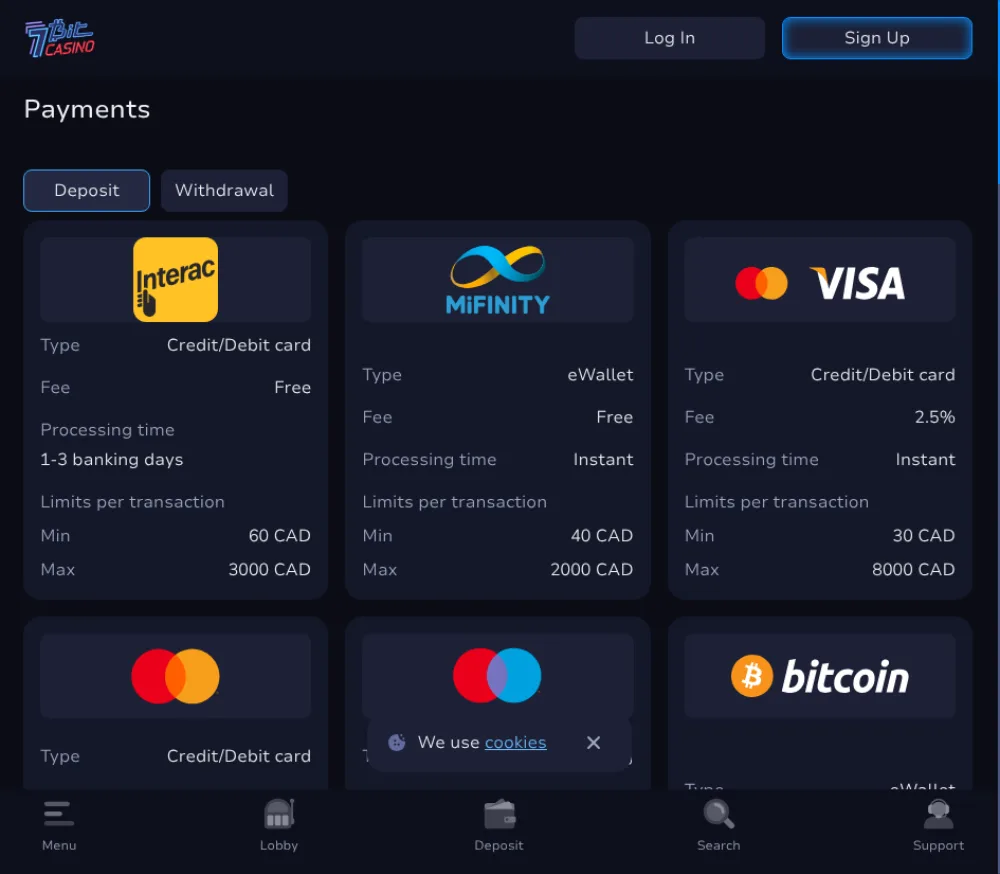
This is the table the cashier gives a Canadian visitor, in the operator’s own order, with its own labels kept intact. The “Type” column is 7Bit’s classification rather than ours, which is why Interac appears as a card and Bitcoin appears as an eWallet.
| Method | Type, as labelled | Fee | Credited in | Minimum | Maximum |
|---|---|---|---|---|---|
| Interac | Credit/Debit card | Free | 1-3 banking days | C$60 | C$3,000 |
| MiFinity | eWallet | Free | Instant | C$40 | C$2,000 |
| Visa | Credit/Debit card | 2.5% | Instant | C$30 | C$8,000 |
| Mastercard | Credit/Debit card | 2.5% | Instant credit | C$30 | C$8,000 |
| Maestro | Credit/Debit card | 2,5%, comma and all, as the tile renders it | Instant | C$30 | C$8,000 |
| Online banking | Online banking | 0% | Instant | C$20 | C$8,000 |
| Bitcoin | eWallet | Network fee only | Instant | C$6 | Not published |
| Neosurf | Voucher | Free | Instant | C$20 | C$20,000 |
| Remaining eWallet tiles | eWallet | Free | Instant | C$3 and C$6 | Not published |
Read the whole thing before you pick a rail, because the spread is wider than it first looks. The cheapest entry on the list costs C$6 and the most expensive floor is C$60, a tenfold difference. One family of methods carries a percentage charge and the rest do not. And the method a Canadian is most likely to reach for first, Interac, is the only one on the page that is not credited immediately.
Interac: first on the page, last to arrive
Interac leading the deposit tab is the clearest evidence that this operator takes Canadian traffic seriously rather than bolting a currency symbol onto a European cashier. Gigadat, the processor that sits behind Interac Online and Interac e-Transfer flows for the gambling sector, appears in the payment logo set, which is consistent with how a Canadian-facing offshore casino normally plumbs this in.
The terms of the tile are less flattering. Interac costs nothing, which is right. It also carries the highest minimum on the page at C$60, a ceiling of C$3,000 that is the lowest of any mainstream rail here, and a processing note reading 1-3 banking days. Banking days, not days: a Friday evening transfer has the weekend in front of it before the clock even starts, and a statutory holiday adds another.
So the rail that feels native to a Canadian player is also the one that takes the longest to show up in the balance. If the plan is to fund an account tonight and play tonight, Interac is the wrong choice on this cashier, and the alternative is sitting one row below it at a lower floor and a higher ceiling.
We do not recommend Interac for a player who wants funds available the same evening. A C$60 minimum that clears over one to three banking days is a poor fit for an impulse deposit, and that is before clause 9.14 adds C$180 of slot turnover on top of it. Online banking does the same job at 0%, credits instantly, starts at C$20 and goes to C$8,000. The only reason to prefer Interac here is a preference for e-Transfer over a bank login, and it is a preference you pay for in days.
What a card deposit costs you
Visa, Mastercard and Maestro all carry a 2.5% fee on this cashier. That is worth pausing on, because most casinos absorb card acquiring costs as a cost of doing business rather than passing them to the depositor. 7Bit shows the charge openly in the fee column, which is better than hiding it, but it is still a charge.
What the page does not say is whether the 2.5% is taken out of the deposit before it reaches your balance or added to what your card is billed. The practical cost is identical either way, so the table below prices it rather than guessing at the mechanics.
| Card deposit | Cost at 2.5% | What the fee buys you |
|---|---|---|
| C$30 (the card minimum) | C$0.75 | Instant credit instead of a banking-day wait |
| C$100 | C$2.50 | Instant credit |
| C$500 | C$12.50 | Instant credit |
| C$1,000 | C$25.00 | Instant credit |
| C$8,000 (the card maximum) | C$200.00 | Instant credit |
Two hundred dollars to move eight thousand is a real number, and it is avoidable. The online banking tile offers the same instant credit at 0%, with the same C$8,000 ceiling and a lower floor. Neosurf and MiFinity are free. Bitcoin costs only what the network charges.
We do not recommend a Visa, Mastercard or Maestro deposit here. There is no feature on the card tile that the 0% online banking tile does not match: both credit instantly, both cap at C$8,000, and the banking tile opens at C$20 against the card’s C$30. Paying 2.5% for an identical outcome is the single most avoidable cost on this page, and at the maximum it is C$200 of your bankroll gone before the first spin.
One further reason to think twice about cards: a chargeback is treated as fraud under the fraud-prevention clause, which lists “initiating chargebacks of transactions or disputing the transactions made” alongside collusion and multiple accounts. A card gives you a dispute mechanism that this operator’s terms explicitly treat as grounds for voiding winnings. The mechanism you are paying 2.5% for is one you cannot safely use.
Online banking and the voucher route
The online banking tile is the quiet winner of this cashier for most Canadian readers. Zero fee, instant credit, C$20 to C$8,000 per transaction, and it works the way paying a bill from a chequing account works. Nothing on the page beats it on cost and nothing beats it on speed except crypto.
Neosurf is the outlier. It is free, instant, opens at C$20 and runs all the way to C$20,000 in a single transaction, which is the highest per-transaction ceiling published anywhere on the deposit tab, more than double what a card or a bank transfer allows. A prepaid voucher is also the one funding route with a structural problem on the way out, and we come to that below.
MiFinity, Paysafecard, Skrill, Neteller, MuchBetter, AstroPay, eZeeWallet and Rapid Transfer all appear in the logo set as well. The published tiles for the tail of that list run down to minimums of C$3 and C$6, with no maximum stated for several of them, which tells you the cashier was built for small, frequent top-ups rather than occasional large ones.
Bitcoin from C$6, and the limit that does not apply to it
7Bit’s own page title calls it a Bitcoin casino, and the cashier backs that up. The Bitcoin tile opens at C$6, credits instantly, publishes no maximum, and charges only the network fee, which the page renders as 0.00002 in the fee column. The account currency list in clause 9.6 runs: EUR, USD, CAD, AUD, NZD, then BTC, ETH, BCH, LTC, DOG, XRP, TRX, ADA, BNB, USDT, USDC and SOL. CAD comes third among the fiat options, and the token list is longer than the fiat one.
Two clauses temper that. Clause 9.13 states plainly that the casino “is not a financial institution and must not be treated as such”, that no interest is paid on deposited funds, and that no conversion or exchange service is offered to players at any time. Read that next to the fact that your account currency is fixed when you sign up and the consequence is clear enough: whichever currency you pick at sign-up is the one you live with, and the casino will not shift you between rails afterwards.
The second clause is the one that should change behaviour. Clause 9.8: “due to the nature of cryptocurrencies, deposit limits cannot be applied to the cryptocurrency deposits.” Deposit limits are the first responsible-gambling tool this site advertises, and they do not function on the funding method the brand is named after. The Canadian support services and the gaps in this toolkit are set out separately, including why a loss limit here stops applying the moment you win.
Anyone leaning on a deposit cap to keep a bankroll in check should fund in dollars. The limit works on the dollar rails and it does not work on the token rails, and that wording is the operator’s, not our inference.
Every payment brand in the logo set
Taken off the cashier and the footer on 20 October 2026, grouped the way a Canadian reader would recognize them:
- Canadian rails: Interac and Gigadat
- Cards: Visa, Mastercard, Maestro, plus AstroPay card and AstroPay direct
- Bank routes: Rapid Transfer and a plain Bank Transfer tile
- eWallets: Skrill, Neteller, MuchBetter, MiFinity and eZeeWallet
- Vouchers and prepaid: Neosurf and Paysafecard
- Exchange: Binance
- Tokens: BTC, ETH, LTC, DOGE, BCH, BNB, XRP, TRX, ADA and USDT
That is a broad set by the standards of the category, and the Canadian end of it is genuine rather than decorative. What the breadth does not change is the rulebook that applies once money is inside, which is what everything below is about.
Floors, ceilings and what happens above them
Every figure in this table is published by the operator, and the clause reference is where we found it. These are the numbers to budget against.
| Rule | Published figure | Clause |
|---|---|---|
| Smallest deposit accepted | C$20, method permitting | 9.7 |
| Smallest withdrawal accepted | C$40, method permitting | 9.9 |
| Weekly payout ceiling | C$20,000, from the first payment that week | 9.10 |
| Monthly payout ceiling | C$80,000, from the first calendar day | 9.10 |
| Balance above the monthly ceiling | Monthly instalments of up to C$80,000 | 9.11 |
| Request above a single method’s cap | Split into instalments | 9.9 |
| Progressive jackpot wins | Subject to full payment | 9.12 |
| Cumulative payments forcing verification | C$4,000 | 9.2 |
| Deposit wagering before a payout | 3x slots, 10x table and live | 9.14 |
Those ceilings only bite near the upper end, but when they bite they bite hard. A C$500,000 balance paid at C$80,000 a month takes seven monthly instalments to clear, during which the rest of it sits in an account at a casino rather than in a bank. The jackpot carve-out in 9.12 is the one piece of good news in that paragraph, and it is explicit: progressive jackpot winnings are subject to full payment rather than instalments.
The weekly figure is the one most players will meet first, and it is measured oddly. Clause 9.10 starts the week “from the first successful payment sent during this week”, not from a fixed Monday, so the window is rolling and depends on when your first payout of the period actually left. The monthly window, by contrast, runs from the first calendar day.
Clause 9.10 also allows the ceilings to be changed “for the players with a higher VIP level at the Casino’s sole discretion”. The loyalty FAQ puts it more plainly: limits are generally the same for everyone, and levels two and above may ask a manager to look at them. We cost the twelve-level ladder rung by rung, including how much turnover a single conversion is worth, because a higher ceiling you have to ask for is not the same thing as a published entitlement.
Where the money has to go back to
Clause 9.4 is the rule that catches people out after the fact: withdrawals, refunds and reversals are processed, “wherever reasonably possible”, only to the original source of the funds. The same clause reserves the right to ask for proof of ownership of that account before anything is sent. Clause 9.5 provides the escape hatch, letting the casino nominate an alternative method where paying back to the original one is impossible, unavailable or prohibited.
That pairing has a specific consequence for two of the Canadian-friendly tiles. A prepaid Neosurf voucher and a Paysafecard cannot receive a payout, because there is nothing to pay back into. Fund with either and your withdrawal route becomes whatever 9.5 lets the casino choose, which you will not know until you ask for money.
Clause 9.3 is blunter and more serious. Third-party payment systems are “expressly prohibited”, the casino disclaims responsibility for funds lost to or from a third-party account, and winnings originating from third-party deposits will be voided. A spouse’s card, a parent’s chequing account, a friend’s wallet: not a technical violation with a warning attached, but a stated basis for voiding the winnings. If the name on the funding method is not the name on the account, nothing downstream of it is safe.
Practical upshot: pick one rail in your own name, fund with it, verify it, and withdraw to it. Mixing funding methods across an account multiplies the proof-of-payment documents you will eventually be asked for, and rejected payouts and stalled checks are a recurring theme in the account problems we document.
What 7Bit does not publish about payouts
Here the honest answer is a blank, and the blank is the finding. The deposit side of this cashier is unusually well documented. The withdrawal side is not documented at all in the places that matter, and rather than borrow a plausible figure from a third-party review we have left the rows empty and named the gap.
| What a Canadian player needs to know | Is it published? | What the site offers instead |
|---|---|---|
| How long a payout sits in review before processing begins | Not published | Nothing. No pending window appears in the terms or the help centre |
| How long each method takes to pay out | Not published | The withdrawal tab repeats the deposit vocabulary rather than replacing it |
| Whether weekends and holidays pause a payout | Not published | “Banking days” appears on the Interac deposit tile and nowhere else |
| Whether a withdrawal carries a fee | Not stated separately | A fee column that describes funding a deposit |
| How many withdrawals you may have open at once | Not published | Only the weekly and monthly ceilings |
| How a KYC review interacts with a pending payout | Not published as a timeline | A 24-hour aim in the help centre against 30 working days in clause 8.5 |
None of those blanks is unique to 7Bit. Plenty of offshore casinos publish deposit times and stay silent on payout times, because the deposit time is a processor fact and the payout time includes a human decision the casino would rather not commit to. It is still the largest single gap in this operator’s disclosure, and it is what holds the score down.
Our breakdown of what happens between a cash-out request and money landing in a chequing account explains the stages a payout passes through and roughly what each one costs in time at a typical operator. It is the nearest thing available to a figure 7Bit will not give.
The one payout figure anywhere on the site
There is exactly one number, and it is marketing. The About page says that “money-outs with bitcoins take less than ten minutes”, and the bonus help section says “Payouts take 10 minutes only”. Both were live when we read them on 20 October 2026.
That claim will not be repeated here as a finding, because we did not withdraw and cannot verify it. What we can say is what the claim is and is not. It is the operator’s own statement about the Bitcoin rail specifically, it appears on a promotional page rather than in the terms, nothing in the terms commits the casino to it, and clause 9.14 together with the verification triggers in clause 8.8 both sit upstream of whatever the blockchain leg takes. A ten-minute transfer at the end of a thirty-working-day document review is still a thirty-working-day wait.
Treat it as a claim with a named source, which is how we have labelled it here, and budget against the contractual ceilings instead.
The checks that stand between a balance and a payout
Verification is where most payout complaints at offshore casinos actually begin, so it belongs on a payments page even though the document detail lives elsewhere. 7Bit publishes its triggers and its document list clearly; what it publishes twice, with two different answers, is how long the review takes.
| Trigger or requirement | What it means for your money | Clause |
|---|---|---|
| Registration | Name, full residential address, date of birth and ID proving age | 8.2 |
| Cumulative payments reaching C$4,000 | Verification becomes obligatory, not discretionary | 9.2 |
| Before a deposit or a withdrawal | Risk-based, at the casino’s discretion | 8.8 |
| Changing payment method or payout destination | Fresh checks on the new rail | 8.8 |
| Proof of address | No older than 90 days at the date of issue | 8.7 |
| Proof of payment | Must show the sum debited, the account holder’s name and the date | 8.7 |
| Source of funds or wealth | Requested “where required”, with no threshold given | 8.7 |
| Video, biometric or liveness check | At the casino’s sole discretion; account actions may be frozen until it clears | 8.12 |
| No contact for two weeks after a payout request | The account is locked for failing KYC | 8.12 |
| Review turnaround | 24 hours in the help centre, up to 30 working days in the terms | 8.5 |
The last two rows are the ones to plan around. Thirty working days is roughly six calendar weeks, and the shorter figure is a service aspiration published on a help page while the longer one is a contractual ceiling. Only one of those is enforceable, and it is not the friendly one.
The two-week rule in clause 8.12 cuts the other way and deserves equal attention: if the casino asks for a document after you request a withdrawal and cannot reach you within two weeks, the account is locked. Request a payout and then go away on holiday without watching the inbox you registered with, and you can come back to a frozen account. Which Canadian documents actually satisfy each requirement is covered in the verification walkthrough, including why a Curaçao licensee’s checks are not FINTRAC checks and what that changes about your recourse.
Leaving an account alone costs C$50 a month
Clause 14.1 turns an account dormant after twelve consecutive months without a login, and from that point the casino may charge “a monthly administrative fee of a minimum 50 CAD” for as long as the balance stays positive. Clause 14.2 sets out the mechanics: you authorize the debit by accepting the terms, it starts at the beginning of the month after dormancy is reached, you are told by email, and it stops either when you log back in or when the balance hits zero.
Note the word “minimum”. The clause sets a floor on the fee, not a cap, which means C$50 is the least it can be rather than the most. Note also what the stopping condition implies. A forgotten balance of C$60 is gone after two months at the minimum rate: C$50 in the first month, the remaining C$10 in the second, and then the charge stops because there is nothing left to charge against.
The defence is trivial and worth putting in a calendar. Log in once a year, or withdraw the balance and close the account properly. The amounts that get caught by a clause like this are exactly the amounts too small to feel worth a withdrawal request, which on this cashier means anything under the C$40 payout floor is already stranded.
When a payment goes wrong
Clause 15 runs longer than most offshore operators bother with, and the time to read it is before anything goes wrong. Complaints cost nothing and have to be raised inside six months of whatever went wrong, through support or a dedicated form on the site. The casino undertakes to acknowledge within one week, explain how the matter will be reviewed, and give an estimated timeline. Reviews are answered within four weeks, extendable once by up to four more weeks if the case is complex, with written notice. Responsible-gambling complaints are prioritized, and the final answer always arrives in writing.
Clause 15.4 then names an external route, which is more than the category norm: 7Bit says it cooperates with EGIS as its independent alternative dispute resolution provider, reachable directly by email. That is a real escalation path and we credit it as one.
What it is not is a Canadian escalation path. There is no AGCO complaint route here, no iGaming Ontario dispute process and no provincial ombudsman, because 7Bit is not registered with any of them. Arbitration under the terms is “exclusively by arbitration in Curacao” under Curaçao civil procedure. What the Curaçao Gaming Authority licence does and does not give a Canadian player is examined on its own page; put briefly, it is the only regulator anywhere in this chain.
Six months is also a shorter window than it sounds when the thing being complained about is a payout that has been pending without explanation. The clock runs from the date of the issue, not from the date you give up waiting.
Pros and cons of this cashier
Pros
- Interac leads the deposit tab, free, with Gigadat behind it and every figure in CAD
- A genuine 0% rail: online banking, instant, C$20 to C$8,000
- Bitcoin deposits from C$6, the lowest entry price on the page
- Neosurf accepts C$20,000 in one transaction, the highest published per-transaction ceiling
- Deposit fees, floors and ceilings are all published rather than revealed at the till
- Progressive jackpot wins are exempt from the instalment rule under clause 9.12
- An independent dispute provider is named, with acknowledgement and decision deadlines attached
- Minimum withdrawal of C$40 is low for the category
Cons
- Clause 9.14 requires 3x slot or 10x table turnover on every deposit, with or without a bonus
- No payout time is published for any method, and no pending window exists in the terms
- Cards cost 2.5%, which is up to C$200 on a maximum deposit
- Interac, the most Canadian rail on the page, takes 1-3 banking days and starts at C$60
- A deposit limit has no effect whatsoever on a token deposit, per clause 9.8
- Verification turnaround is quoted as 24 hours in one place and 30 working days in another
- A balance over C$80,000 is released in monthly instalments, not in one payment
- Dormancy costs a minimum of C$50 a month after twelve months, with no stated maximum
- Prepaid vouchers cannot receive a payout, leaving the route to the casino’s discretion
- The only payout figure anywhere is a marketing claim about Bitcoin
The verdict on 7Bit’s cashier
5.8 out of 10. The deduction is almost entirely about disclosure rather than cost. The worst thing here is clause 9.14, a deposit-wagering rule that applies to players who took no bonus, lives in the payments policy where nobody reads it, and lets the casino cancel a payout until it is satisfied. Next to it sits the blank where a payout time should be: no pending window, no per-method figure, no weekend note, and a single ten-minute marketing claim doing the work that a published processing table ought to do. Those two things together mean a Canadian cannot answer the only question that matters, which is when the money arrives.
Build back up from there and the picture improves. Funding an account here is better documented than at most rivals, it is quoted in real Canadian dollars, Interac and Gigadat are plumbed in properly rather than badged on, online banking does the whole job at 0%, and the floors are low enough that a cautious reader can see the lobby for C$6. The limits are published, the jackpot exemption is explicit, the complaint timetable is written down and an external dispute provider is actually named. That is a cashier built by people who have handled Canadian traffic before.
What keeps the number under six is that the good parts all describe money going in and the gaps all describe money coming out. Read 9.14 before you fund, pick the 0% rail, keep the funding method in your own name, and get documents in early rather than at the point of a withdrawal. Our scored assessment of the whole operation places this alongside the catalogue, bonus and licence findings and lands a point and a half higher, which tells you where the weakness sits.
Common questions about 7Bit payments
How much of a C$200 deposit has to be staked before a cash-out?
C$600 if you play slots, or C$2,000 at a table or in front of a live dealer. Clause 9.14 fixes the multipliers at three and ten respectively, and taking no promotion at all does not exempt you. The casino may hold a payment until the turnover is covered.
What is the smallest sum 7Bit will send out?
C$40, subject to whatever the individual method allows, under clause 9.9. Anything below that floor cannot be requested, which matters for a small residual balance because clause 14.1 will begin charging an administrative fee against it after a year of no logins.
Can money come back out through Interac e-Transfer?
There is no separate Canadian payout list on the cashier, so we cannot confirm it method by method. Clause 9.4 sends withdrawals back to whatever funded them wherever that is reasonably possible, and clause 9.5 hands the choice to the casino when it is not. Fund with Interac and the same rail is the stated default.
Why does a card deposit carry a 2.5% charge?
The cashier simply lists it in the fee column for Visa, Mastercard and Maestro without explaining it, which usually means the acquiring cost is being passed on rather than absorbed. Nor is it stated whether the charge comes out of the credit or goes onto the card billing. Online banking performs the same instant transfer at 0%.
How long does 7Bit take to send a payout?
It does not say, and that is the honest answer. The withdrawal tab echoes the deposit processing times rather than giving its own, no pending or review period appears in the terms, and the only figure published anywhere is an About-page claim of under ten minutes for Bitcoin, which we have not tested.
What happens to a balance above C$80,000?
Clause 9.11 lets the casino release it in monthly tranches capped at C$80,000 each until the whole sum has been paid, with the C$20,000 weekly ceiling applying underneath. Progressive jackpot wins are the one stated exception and must be paid in full under clause 9.12.
What does 7Bit do to an account nobody logs into?
A year with nobody signing in flips the account to dormant status, and from there an administrative charge of at least C$50 a month applies while any balance remains. An email warns you, the first debit lands in the month after the status changes, and the charge ends on your next sign-in or when the balance empties.
At what point does verification become compulsory?
Clause 9.2 makes it obligatory once cumulative payments reach C$4,000. Before that it is risk-based: clause 8.8 allows checks at registration, before a deposit or withdrawal, on a change of payment details, and whenever activity looks inconsistent. Proof of address has to be under 90 days old.
Can somebody else’s card or wallet fund the account?
No. Clause 9.3 bans third-party payment systems outright, disclaims responsibility for anything that moves through one, and voids any winnings traced back to such a deposit. Whoever owns the card or wallet must be the registered account holder.
Where does a complaint about a payment go?
To 7Bit first, at no cost, and no later than six months after the event, via support or the complaints form. Acknowledgement is promised inside a week and a decision inside four weeks, extendable once. If that fails, clause 15.4 names EGIS as the external dispute provider. No Canadian regulator is involved at any stage.
Sources
- 7Bit Casino payments page, rendered through a Canadian exit on 20 October 2026: the deposit tiles, their fees, processing notes and per-transaction limits in CAD, and the payment logo set counted off the footer.
- The 7Bit terms and conditions, payments policy: clauses 9.1 through 9.14, covering currencies, third-party rules, the withdrawal floors and ceilings, the instalment provision and the deposit-wagering requirement.
- Section 8 of those terms: the verification triggers, the document list, the 90-day proof-of-address rule, the video-call reservation and the two conflicting review timelines.
- Sections 10, 14 and 15: chargebacks treated as fraud, the dormant-account fee, the complaint timetable and the EGIS dispute route.
- 7Bit Casino About page and help centre: the sub-ten-minute Bitcoin payout claim, quoted here as the operator’s own marketing rather than as a measured figure.
- Interac Corp. and Gigadat: how e-Transfer and online banking settlement works over Canadian banking days, for context on the 1-3 day deposit note.